
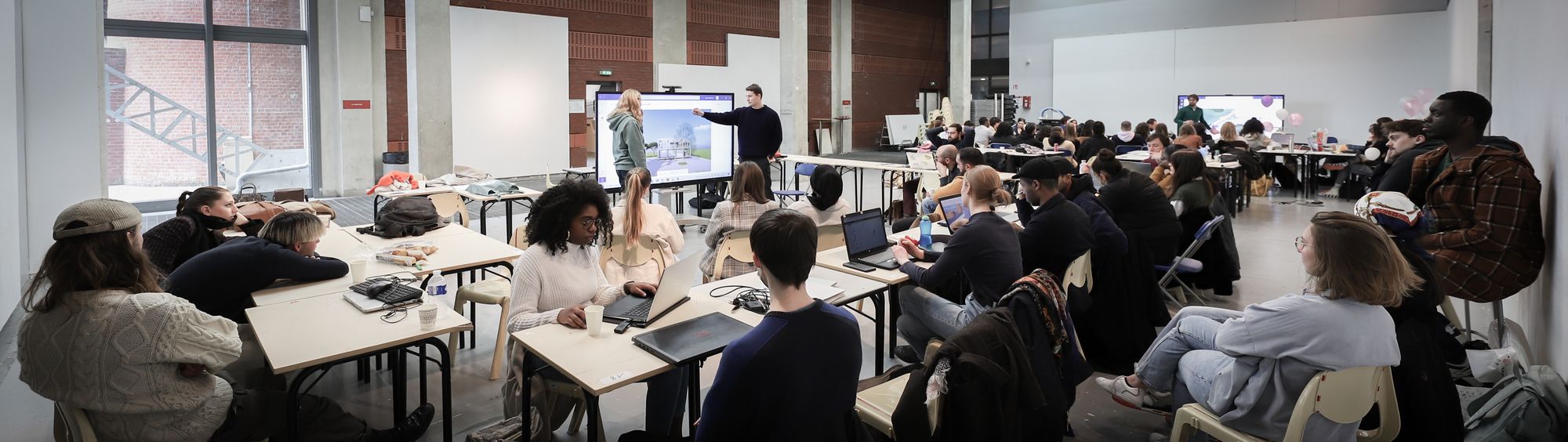
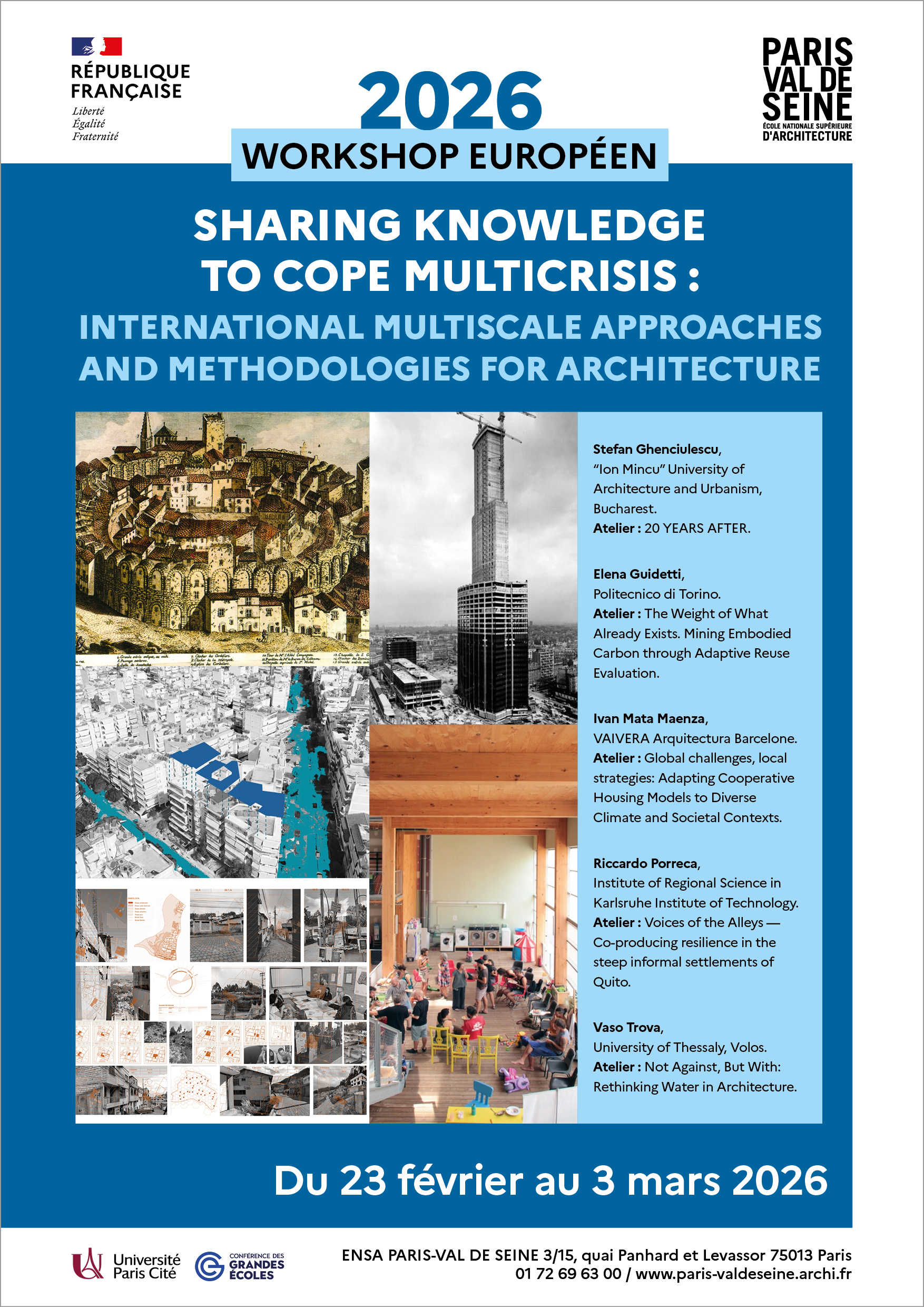
WORKSHOP EUROPÉEN : Sharing knowledge to cope multicrisis
Étudiants moniteurs :
Beni Alessia, Bouafia Neila, Feleo Adelle, Habran Alice, Lam William, Mazri Inès, Meeus Corentin, Peyruse Nathan, Podversic Jakob, Sottilini Chiara
“International multiscale approaches and methodologies for architecture”
L’édition 2026 s'est tenue du lundi 23 février au vendredi 3 mars 2026.
Le workshop européen est organisé pour les étudiants du semestre 8 en M1. Il est animé par des enseignants architectes invités de toute l’Europe, autour d’une problématique commune à l’ensemble. Il se conclut par des présentations des travaux.
Le workshop européen 2026 a pour titre “Sharing knowledge to cope multicrisis : international multiscale approaches and methodologies for architecture” et sera coordonné par Francesca Contrada et Emma Filipponi.
L’architecture se trouve aujourd’hui au croisement de crises multiples environnementales, climatiques, sociales, politiques – qui mettent en question ses fondements théoriques, ses modes d’action et ses finalités. Ces crises ne se manifestent pas uniquement à l’échelle du projet ou de l’édifice : elles engagent également les formes de la ville et les dynamiques des territoires. Dès lors, penser l’architecture dans ce contexte revient à interroger sa capacité à articuler différentes échelles et à renouveler ses instruments conceptuels comme opérationnels.
Le workshop européen est un moment privilégié dans le cycle master, il répond à plusieurs objectifs pédagogiques :
- Accueillir au sein de l’École des pédagogies et des approches différentes ou complémentaires de celles qui sont proposées par l'ENSA Paris-Val de Seine
- Produire dans un temps réduit un exercice et une réflexion collective autour d’une question d’architecture ou d'urbanisme.
Le workshop européen « Sharing knowledge to cope multicrisis : international multiscale approaches and méthodologies for architecture » se propose comme un espace de confrontation intellectuelle et d’expérimentation collective. Réunissant étudiants, enseignants, chercheurs et praticiens issus de divers contextes culturels, il vise à mettre en dialogue approches théoriques et pratiques, à croiser disciplines et expériences, afin de produire une réflexion partagée sur les enjeux contemporains de l’architecture.
Les ateliers thématiques permettront d’examiner plusieurs dimensions : comment concevoir des stratégies architecturales et urbaines dans un contexte de raréfaction des ressources ? Comment penser la résilience de la ville et la durabilité des formes construites dans une perspective critique, attentive aux inégalités sociales et aux enjeux de gouvernance ?
Plutôt qu’un simple constat de crise, ce workshop cherche à identifier des pistes de recherche et d’action, à expérimenter de nouvelles narrations et à explorer des modèles alternatifs de conception. L’ambition est de contribuer à une pensée architecturale capable de compléter le cadre du projet et de s’inscrire dans une compréhension élargie des processus territoriaux et urbains.
Par son caractère transnational et interdisciplinaire, l’événement aspire à renforcer une dynamique de recherche européenne, en dotant l’architecture d’outils critiques et prospectifs pour affronter les défis contemporains et esquisser des horizons communs.
LES INVITÉS CETTE ANNÉE SONT :
- Ștefan Ghenciulescu - Assistant Professor at “Ion Mincu” University of Architecture and Urbanism, Romanie.
- Elena Guidetti - PhD, Assistant Professor - Politecnico di Torino, Italy.
- Ivan Mata Maenza - Architect - Vaivera Arquitectura, Spain.
- Riccardo Porreca - Associate Researcher at the Institute of Regional Science in Karlsruhe Institute of Technology, Germany.
- Vaso Trova - Professor of Architecture and Urban Design at the Dept. of Architecture UTH, Greece.
PROGRAMME DES CONFÉRENCES
En amphis et à suivre en direct sur notre chaîne YouTube
Lundi 23 février 9h : Lancement du Workshop Européen 2026
Mardi 24 février : Conférences - Building and society
- Session 1 | Amphi 180 : 12h-13h Ivan MATA MAENZA et Sabri BENDIMERAD
- Session 2 | Amphi 180 :14h-15h Christel PALANT FRAPIER et Elena GUIDETTI
Mercredi 25 février : Conférences - Urban and Resources
- Session 1 | Amphi 310 : 12h-13h Riccardo PORRECA et Nils LE BOT
- Session 2 | Amphi 180 :14h-15h Carmen POPESCU et Ștefan GHENCIULESCU
Jeudi 26 février 2026 : Conférences - Landscapes and Resilience
- Session 1 | Amphi 180 : 12h-13h Mathieu MERCURIALI et Vaso TROVA
- Session 2 | Amphi 180 : 14h-15h Sara ALQATAA et Rita KHALAF
Mardi 3 mars 2026 : Restitution et clôture du Workshop
- 9h: Restitution des travaux du workshop
- 14h | Amphi 180 : Conférence : First Nation thinking, Oliver Page, directeur général de Snøhetta, invité dans les cadre de l'enseignement de Charles-Albert DE BEAUVAIS
- 15h : Clôture des travaux et vernissage de l’exposition en salle expérimentation
Du 3 au 13 Mars 2026 : Exposition ouverte en salle expérimentation.
Présentation des enseignants invités
Stefan Ghenciulescu

Ștefan Ghenciulescu is an architect, curator and critic.
He’s the editor of Zeppelin architecture magazine, and an assistant professor at the “Ion Mincu” University of Architecture and Urbanism, Bucharest. He has also been teaching at the TU Wien.
Ștefan’s main research areas are contemporary architecture and the city, historical modernity, Eastern Europe, public space and the commons. His practice focuses mainly on the transformation of existing buildings and exhibition design.
Riccardo Porreca
Architect and urban planner with Master’s and PhD in Architecture from La Sapienza University, Rome. He served as tenured Professor of Architectural Design and Theory at UTE University, Quito (2019–2025). He is currently Associate Researcher at the Institute of Regional Science (Karlsruhe Institute of Technology), having completed a Marie Curie Postdoc on habitat co-production. His research focuses on collaborative development of sustainable, resilient, inclusive urban environments within marginalised territories, with consultancy for municipalities in Italy and Ecuador.
Elena Guidetti

Elena Guidetti is an architect and PhD, currently serving as Assistant Professor at the Department of Architecture and Design at Politecnico di Torino. She is also a member of the Future Urban Legacy Lab research center.
In 2022, she earned her PhD in "Architecture. History and Project" from Politecnico di Torino, focusing on the transformative potential of existing buildings in post-functional Europe. Her research explores adaptive reuse through a morphological perspective, analyzing stages of completeness and embodied energy to develop sustainable strategies for urban and architectural adaptation. Her expertise lies in urban and architectural design strategies, employing research-by-design methodologies to uncover innovative approaches for repurposing built legacies. She adopts an interdisciplinary perspective, integrating preservation theory, design, and sustainability studies to address contemporary urban challenges.
Since 2018, she has collaborated with Politecnico di Torino, Faculdade de Arquitectura do Porto, and the universities of Ferrara, Hasselt, Sarajevo, Dessau, and Polis Tirana on various academic and research initiatives. Elena is also an editor at Ardeth Journal and ProArc Intersezioni Journal, contributing to the discourse on architecture and design.
Ivan Mata Maenza
IvanMata Maenza obtained the Master's degree in Architecture from ETSAB (Technical School of Architecture of Barcelona) in 2005. After collaborating with local agencies in Barcelona, his career became more international starting in 2004. Following an Erasmus year at Paris-La Villette (2003), he worked for several years with Ateliers Jean Nouvel. Between 2008 and 2009, he lived in Rotterdam and joined OMA. He then settled permanently in Paris in 2009, working on projects in cities like Bamako, Bordeaux, and Copenhagen, both independently and in collaboration with renowned agencies such as AJN, OMA, the Danish agency BIG, and the Paris-based FREAKS. In 2020 he obtained a specialized university diploma in eco-responsible construction from the Gustave Eiffel University. In 2023, he co-founded Estudi Vaivera with Fina Urpí in Barcelona to develop architecture that responds to contemporary environmental and societal challenges. Ivan has worked on significant cultural projects, such as La Méca in Bordeaux, the refurbishment of the Strasbourg Zoological Museum, and the French Institute in Barcelona. His interest in housing and bioclimatic solutions is currently reflected in a cooperative housing project in Vilafranca del Penedès, focusing on optimizing wooden structures and bioclimatic atriums. In addition to his professional work, Ivan has collaborated with Roma-La Sapienza University (Italy) for summer workshops and contributed as an expert nominator for the Mies van der Rohe Foundation in Barcelona. He also taught architectural design courses at ENSA Paris-Val de Seine between 2022 and 2025.
Vaso Trova

Professor of Architecture and Urban Design at the Dept. of Architecture UTH, Greece. Director of the Urban Design Lab, UTH. Visiting prof. at LSBU, Politecnico di Milano, University of Lisbon. As a practicing architect, she has designed and implemented various projects in Greece, she has won prizes in architectural competitions and has participated in exhibitions in Greece and abroad. Her research focuses on design issues in reference to contemporary urban phenomena, design in crisis conditions, urban commons, urban history.